

Does Freezing Coffee Beans Keep Them Fresh?
Table of Contents
- How Freezing Affects Coffee Bean Freshness
- How to Tell If Coffee Is Fresh: Signs of Stale Beans
- How Long Do Coffee Beans Last in the Freezer?
- Freezing Coffee Beans Vacuum Sealed: Why Airtight Matters
- How to Thaw and Use Frozen Coffee Beans Correctly
- Common Mistakes That Ruin Frozen Coffee Beans
- Frequently Asked Questions
Last Updated: September 14, 2026
How Freezing Affects Coffee Bean Freshness
Yes, freezing coffee beans keeps them fresh if you manage moisture and oxygen. Freezing slows the chemical reactions that cause staling but does not stop them. The real enemy is not the cold; it is the water vapor that forms when beans move between temperatures.
This guide from Marilyn’s Morning Brew breaks down what happens at sub-zero temperatures, why condensation ruins more coffee than time does, and how to build a freezing routine that protects your flavor.
There is a stubborn myth worth killing early: that the freezer is where good coffee goes to die. That was true for the paper bag in your pantry door, not for whole beans sealed properly and stored at a stable temperature. Cold slows oxidation, the process where oxygen reacts with the oils and volatile compounds that create aroma, which means a longer shelf-life.
What freezing cannot fix is damage you cause on the way in or the way out.
What Happens to Beans at Sub-Zero Temperatures
At sub-zero temperatures, the volatile compounds responsible for aroma become far less reactive. Oxidation and degassing slow to a crawl, so frozen beans can hold peak freshness for months rather than weeks.
The catch is temperature fluctuation. Every time the freezer door opens, the interior warms slightly. Beans in a thin bag that lets air in cycle through small temperature swings, and each swing draws moisture toward the surface.
Why Moisture and Condensation Are the Real Threats
Moisture, not cold, degrades frozen coffee. Coffee beans are porous and absorb water vapor readily, so when a cold bean meets warm room air, condensation forms on its surface within seconds.
That surface water speeds oxidation and carries dissolved oxygen straight into the bean. A bean that looks dry can already be compromised by moisture pulled in during a careless thaw.
How to Tell If Coffee Is Fresh: Signs of Stale Beans
Learning how to tell if coffee is fresh comes down to four senses: smell, sound, sight, and taste. Fresh whole beans give off a strong, sweet aroma and crack audibly when bitten.
Here is what to check before you blame your brewing method:
- Aroma: Fresh beans smell sweet and complex. Stale beans smell flat, papery, or vaguely like cardboard.
- Sound: Bite a bean. A sharp crack signals good internal structure. A soft thud means it has absorbed moisture.
- Surface: Oily sheen on a dark roast is normal. Oily sheen on a medium roast that was matte last week means oxidation has begun.
- Bloom: Pour hot water over fresh grounds and they swell and bubble. Flat, lifeless grounds have already lost their gas.
The National Coffee Association's guidance on coffee storage notes that oxygen, heat, light, and moisture are the four factors that degrade coffee, which is exactly why a sealed, dark, cold environment works.
How Long Do Coffee Beans Last in the Freezer?
Whole coffee beans last roughly one to two months sealed at room temperature and up to six months or longer frozen at a stable temperature (Storage and shelf life - NCA). The timeline depends far more on packaging than on the calendar.
For how long do coffee beans last, think in tiers:
| Storage Method | Approximate Shelf-Life | Flavor Retention |
|---|---|---|
| Open bag, room temperature | 1-2 weeks | Poor; rapid staling |
| Sealed bag, room temperature | 1-2 months | Good for the first month |
| Ziplock bag, freezer | 2-3 months | Fair; prone to freezer burn |
| Vacuum-sealed, freezer | 6-12 months | Excellent if never thawed and refrozen |
The variable that matters most is whether air can reach the beans. A ziplock bag is better than nothing but is not airtight in any meaningful sense.
Whole Bean vs. Pre-Ground: Does It Change the Timeline?
Pre-ground coffee loses freshness far faster than whole bean, frozen or not. Grinding exposes a vastly larger surface area to oxygen, so pre-ground coffee oxidizes and degasses in days rather than months.
If you must freeze pre-ground coffee, vacuum seal it and use it within a month. The practical answer for anyone chasing peak freshness is to freeze whole bean and grind immediately before brewing.
Freezing Coffee Beans Vacuum Sealed: Why Airtight Matters
Freezing coffee beans vacuum sealed is the most effective preservation method for home storage. Removing air eliminates the oxygen that drives oxidation and prevents freezer burn from moisture migrating out of the beans.
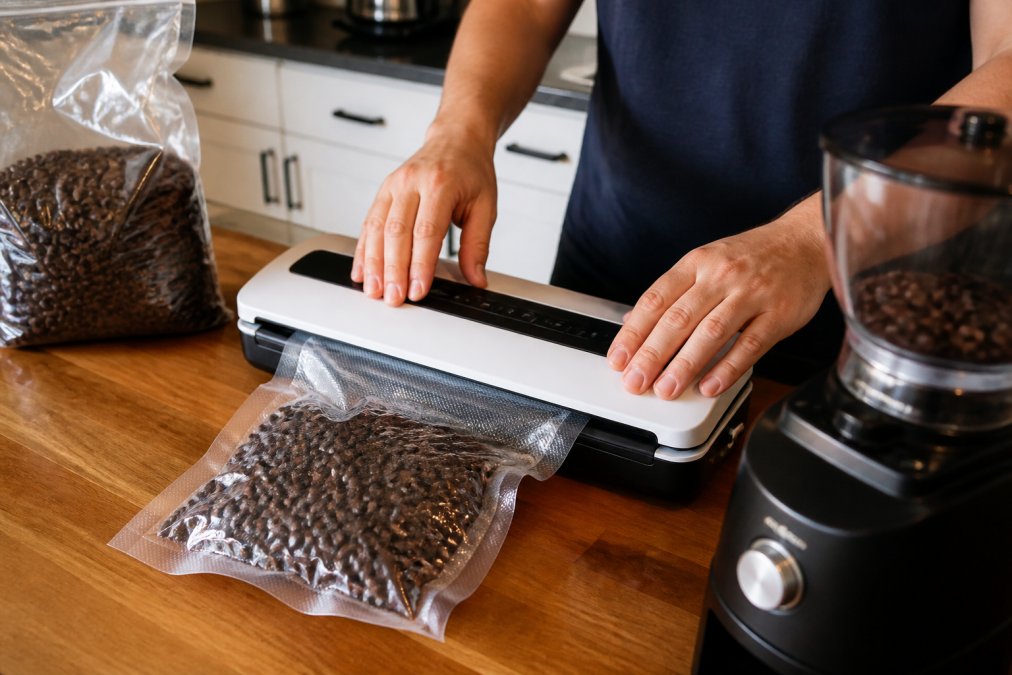
Airtight does not mean "mostly closed"; it means no gas exchange. A sealed container, a vacuum seal, or a mason jar packed to the brim all limit oxygen exposure. A ziplock bag with air pressed out by hand is the weakest option.
How Freezer Odors Get Into Your Beans
There is a second, quieter problem: freezer odors. Coffee beans are porous and absorb whatever is around them. Beans stored next to frozen fish or last week's leftovers will taste like it. A vacuum seal solves this too, because the barrier works in both directions.
Volatile aroma compounds in frozen food, the sulfur compounds in fish, the alliums in leftover pasta sauce, the phenols in smoked meat, sublimate slowly even at 0°F, become airborne, and diffuse toward any surface they can reach. Coffee beans are hygroscopic and lipophilic: their porous structure and oil-coated cell walls readily adsorb airborne volatiles. A thin polyethylene bag is not a meaningful barrier; molecules migrate through the polymer over weeks. A vacuum-sealed multilayer film or a rigid glass jar with a gasketed lid is.
In most home freezers, the coldest, most stable spot is also the smelliest, because that is where the ice cream and frozen fish live. If you cannot dedicate a shelf, dedicate a rigid outer container, a sealed plastic bin or large mason jar, to isolate your coffee portions.
Choosing a Barrier: Vacuum Sealer vs. Valve Bag vs. Rigid Container
Each option trades convenience against barrier strength:
- Vacuum sealer with multilayer film: Best barrier against both oxygen and odors. Removes most headspace air, which also limits the oxygen available for oxidation. The trade-off is cost and the risk of crushing beans if the vacuum is too strong; use a gentle or pulse setting for whole bean.
- Original one-way valve bag, valve taped shut: The valve is designed to let carbon dioxide escape, not to keep oxygen out. Taping it closed and placing the bag inside a second airtight container gets you most of the way there. This is the best zero-cost option.
- Rigid airtight container (mason jar, gasketed canister): Excellent odor barrier, reusable, and easy to portion. It does not remove headspace air, so it is best paired with a full fill or a small dose size.
- Ziplock bag: The weakest option. The seal is not gas-tight, the film is thin, and odors migrate through it. Use it only as an outer layer around a better container.
If you are not ready to buy a vacuum sealer, use the original one-way valve bag, tape the valve, then place it inside a second airtight container. Not perfect, but a meaningful improvement over a bare bag.
Label every portion with the roast date and the freeze date before it goes in. Frozen beans hold peak flavor for months, but the clock still runs, a portion frozen six months ago is not the same as one frozen last week, and the label is the only way to know which is which.
How to Thaw and Use Frozen Coffee Beans Correctly
Thaw frozen coffee beans inside their sealed container at room temperature for at least two to four hours before grinding. Opening the container early causes condensation, which ruins the batch. Understanding why condensation forms changes how you handle every step.
The Physics of Condensation on Cold Beans
Condensation is not caused by cold but by warm air meeting a surface below the air's dew point, the temperature at which air can no longer hold its dissolved water vapor. Room air at 70°F and 50% relative humidity has a dew point near 50°F. A bean pulled from a 0°F freezer is roughly 50 degrees below that threshold, so water vapor condenses directly onto its surface the instant it touches room air.
Coffee beans are hygroscopic: their porous cell structure is lined with oils and soluble compounds that readily bind water. Once liquid water sits on the surface, it dissolves aromatic compounds and carries them off the bean, and it drags dissolved oxygen into the interior, accelerating oxidation of the oils. A bean that feels dry thirty seconds after opening can already have a compromised surface layer.
The practical takeaway: do not thaw beans quickly. Let their temperature rise to room temperature while the container stays sealed, so surrounding moisture never has a cold surface to condense onto.
Step-by-Step Thawing Without Condensation
- Pull the sealed portion from the freezer and set it on the counter, still closed. Do not open it, and do not puncture the bag to "let air in."
- Wait two to four hours for the beans to reach room temperature. A single-dose vial needs closer to two hours; a one-pound vacuum-sealed brick needs four or more.
- Keep the container closed the entire time. The interior air warms with the beans, so no temperature differential exists when you finally open it.
- Check the container is dry on the outside before opening. Wipe off any frost or beads of water so none drips inside.
- Open only after the beans are fully warmed. If the outside of the bag still feels cold, wait longer.
- Grind immediately and brew. Do not return thawed beans to the freezer.
That last point matters more than people expect. Re-freezing thawed beans introduces a second condensation cycle, and each cycle pulls more moisture into the bean. Once thawed, a portion is a room-temperature portion.
Single-Dose Freezing: The Workflow That Eliminates Thawing Risk
The most reliable way to avoid condensation is to never thaw more than you brew. Portion beans into single-dose containers before freezing, one dose per brew, sealed individually. Small centrifuge tubes, 50 mL conical vials, or narrow mason jars all work; the container needs an airtight seal and enough headspace to avoid crushing the beans.
A single-dose workflow looks like this:
- Weigh out your typical brew dose (commonly 15-22 grams for a pour-over or drip batch).
- Seal each dose in its own airtight container and label it with the roast date.
- Freeze the doses flat so they stack and thaw evenly.
- Pull one dose the night before or the morning of, leave it sealed on the counter, and grind when it reaches room temperature.
The payoff: the rest of your batch never experiences a temperature swing. No partial bag to reseal, no half-thawed portion to refreeze, no open container releasing cold air into a warm room. It is the biggest upgrade most home setups can make, costing nothing beyond a few small containers.
The entire freezing workflow comes down to one rule: keep the beans sealed while their temperature changes. Condensation only forms when cold beans meet warm, humid air, and a sealed container prevents that meeting.
Common Mistakes That Ruin Frozen Coffee Beans
The most common mistakes are opening the bag too early, using a thin ziplock instead of a true airtight seal, and re-freezing thawed portions. Each introduces moisture that undoes the benefit of freezing.
Watch for these in your own routine:
- Freezing beans that were already stale. Freezing preserves freshness; it does not restore it. Start with beans near peak freshness.
- Skipping portioning. One large bag means repeated thaw-and-refreeze cycles for the whole batch.
- Storing near strong-smelling food. Porous beans absorb freezer odors through any barrier that is not truly airtight.
- Grinding before freezing out of convenience. It feels efficient and it costs you weeks of flavor.
- Thawing on the counter in an open bag. This is the single fastest way to introduce condensation.
If you are coming from grocery store beans, expect the difference first in aroma, then in the bloom. Beans roasted to order and frozen properly taste noticeably sweeter and more complex than beans that sat on a shelf for months.
Marilyn’s Morning Brew roasts each batch to order, which means your beans arrive near peak freshness rather than after a long warehouse stay. For anyone building a freezing routine, starting with fresh beans is the whole point. The Specialty Coffee Association's standards for green and roasted coffee treat freshness as a measurable quality factor, not a marketing claim.
Our Best Sellers Sample Pack at $24.99 is a practical way to test which roasts you want to stock in the freezer, and the House Blend at $23.99 holds up well to freezing thanks to its balanced, consistent profile.


Frequently Asked Questions
How long will coffee beans stay fresh in the freezer?
Whole bean coffee holds peak flavor in the freezer for about one to two months, though it can stay safe to drink much longer. After two months, the oils begin to fade and the flavor profile flattens even if the beans are kept cold. For the best cup, freeze in single-dose portions and use them within four to six weeks. Pre-ground coffee loses its aroma faster, so aim for one month or less.
Does freezing coffee beans affect the flavor profile?
Freezing does not harm flavor when done correctly. The cold slows oxidation and preserves volatile compounds that carry aroma. Problems arise from moisture, freezer odors, and temperature fluctuation, not the cold itself. If you seal beans in an airtight or vacuum-sealed container and thaw them without opening the bag, the flavor profile stays close to what it was on roast day. Stale or freezer-burned beans taste flat and papery.
Is it better to store coffee beans in the fridge or freezer?
The freezer is the better choice for long-term storage. A refrigerator cycles through temperature changes each time the door opens, and its humidity promotes condensation on the beans. The freezer stays consistently sub-zero, which slows oxidation and preserves freshness. Use the fridge only for short-term storage of a small amount you plan to finish within a week, and always keep beans in an airtight container away from strong-smelling foods.
How do you properly thaw frozen coffee beans?
Leave the sealed bag on the counter at room temperature for 30 to 60 minutes before grinding. Do not open the bag while the beans are still cold, because condensation will form on the surface and introduce moisture. Once thawed, grind immediately and brew. If you only need a small amount, take out a single-dose portion and let it sit sealed until it reaches room temperature. Never refreeze beans after thawing.
Freezing coffee beans works, but only if you control moisture and oxygen at every step. The beans themselves are not fragile; the handling around them is where flavor is lost. Marilyn’s Morning Brew roasts to order and ships fast so your beans reach you fresh enough to be worth preserving. Order a sample pack or a full bag, portion it, seal it, and let the freezer do the rest.