

How to Find High Quality Tea: An Expert Buyer's Guide
Table of Contents
- Visual and Sensory Clues That Reveal High Quality Tea
- Tea Grading Systems Explained: What Labels Actually Mean
- Single-Origin vs. Blended Teas: Which Tells You More About Quality
- How to Store Tea Properly So Freshness Lasts
- How to Brew Loose Leaf Tea for the Best Flavor
- Tea Fraud, Mislabeling, and How to Spot Both
- Budget-to-Quality Ratio: What You Get at Every Price
- Conclusion
- Frequently Asked Questions
Last Updated: September 17, 2026
Visual and Sensory Clues That Reveal High Quality Tea
Learning how to find high quality tea starts with your eyes and nose, not the price tag. Whole leaf tea should look intact, evenly colored, and smell like the plant it came from. At Marilyn’s Morning Brew, we source from trusted farms.

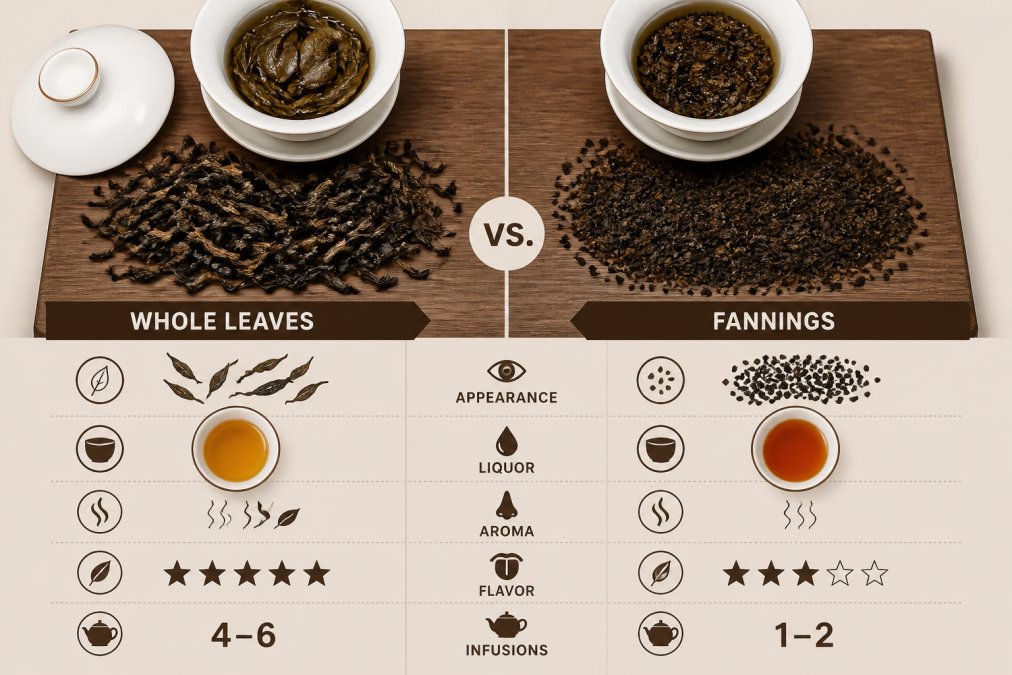
What Whole Leaves Look Like vs. Fannings and Dust
Whole leaf tea is unbroken leaves, often rolled or twisted, that unfurl slowly when steeped. Fannings are the small broken bits left after sorting, and dust is the fine powder at the bottom of a bag. Both brew fast and turn bitter fast, which is why most mass-market tea bags use them. Whole leaves release flavor gradually, giving a smoother, more complex cup.
Aroma, Liquor Color, and Mouthfeel
Aroma should hit you before the first sip: floral, toasty, or grassy depending on cultivar and processing. A bright, clear liquor signals fresh leaf; a muddy color suggests age or poor storage. Mouthfeel is the tell most people miss: high quality tea coats the tongue with body and leaves a clean finish rather than a dry, astringent bite.
Tea Grading Systems Explained: What Labels Actually Mean
Tea grading systems explained honestly: most letters on a package describe leaf size and appearance, not flavor. Terms like FTGFOP, OP, and BOP come from the orthodox black tea trade and tell you how the leaf was sorted, not how it tastes. A large leaf grade can still be stale; a modest grade can still be delicious.
How the Letters Stack Up
Read a grade left to right and it tells a story about leaf size and tip content:
- S (Special) and F (Fine) are marketing prefixes signaling estate pride, not a measurable standard.
- T (Tippy) means a meaningful share of buds, the young, downy shoots that carry sweetness and aroma.
- G (Golden) means tips are visible and golden after oxidation, a sign of careful handling.
- F (Flowery) refers to leaf appearance, not floral flavor.
- OP (Orange Pekoe) is the baseline whole-leaf grade, with nothing to do with oranges.
- B (Broken) means the leaf was cut, speeding extraction and increasing strength at the cost of nuance.
- P (Pekoe) and PS (Pekoe Souchong) describe progressively smaller leaf pieces.
- Fannings and Dust are the smallest siftings, used almost exclusively in tea bags.
What the Table Actually Tells You
| Label | What It Means | What It Does Not Tell You |
|---|---|---|
| SFTGFOP / FTGFOP | Very fine, tippy whole leaf | Flavor or freshness |
| TGFOP | Tippy whole leaf with golden tips | Origin quality |
| OP (Orange Pekoe) | Long, unbroken leaf | Steeping strength |
| BOP (Broken Orange Pekoe) | Smaller broken leaf | Origin or cultivar |
| Fannings / Dust | Fine particles for bags | Nothing about quality |
Where the System Breaks Down
The orthodox black tea grades are useful for Ceylon, Assam, Darjeeling, and Nilgiri, but meaningless elsewhere:
- Chinese teas are graded by a numbered system (often 1-9, lower numbers meaning higher grades) or by picking standard, a "pre-Qingming" green tea refers to a harvest window, not a leaf size.
- Japanese teas use their own vocabulary: gyokuro, sencha, matcha, kukicha. Grade is implied by style and shading, not letters.
- Oolong is described by cultivar, elevation, oxidation, and roast level. A "Dong Ding" or "Da Hong Pao" label carries more information than any letter code.
- Pu-erh is graded by leaf size, raw (sheng) or ripe (shou) style, and age. OP and BOP do not apply.
How to Actually Use Grades When Buying
Treat the grade as one data point among several:

- Check the harvest date. A 2024 OP is almost always a better cup than a 2019 SFTGFOP.
- Check origin specificity. "Darjeeling" is a region; "Darjeeling, Margaret's Hope, first flush" is a traceable lot worth more.
- Check the leaf in the bag. If the package claims whole leaf but you see broken bits and dust, the grade is aspirational.
- Ignore the prefix arms race. SFTGFOP1 is not meaningfully better than FTGFOP.
A Quick Note on "Orange Pekoe"
The most common confusion in tea grading is "Orange Pekoe." It does not mean orange flavor and does not come from the fruit. The most repeated explanation ties it to the Dutch House of Orange, which held sway over the early European tea trade, combined with pekoe, a transliteration of a Chinese term for the downy white hairs on young buds.
Single-Origin vs. Blended Teas: Which Tells You More About Quality
Single-origin tea comes from one estate, region, or harvest, so you can taste the terroir and judge the leaf on its own merits. Blended tea combines leaves from multiple sources for a consistent flavor profile. Neither is automatically better, but they answer different questions.
How to Store Tea Properly So Freshness Lasts
How to store tea properly comes down to four enemies: light, heat, air, and moisture. Keep tea in an airtight container away from the stove and windows, and buy quantities you will finish within a few months.
- Airtight storage: Use a sealed tin or a vacuum sealed bag, not a folded paper pouch.
- Cool and dark: A cupboard beats a countertop jar every time.
- Small batches: Repackage bulk orders into smaller portions so you open one at a time.
- Keep it away from spices: Tea absorbs surrounding odors quickly.
How to Brew Loose Leaf Tea for the Best Flavor
How to brew loose leaf tea well is mostly about water temperature and time. Get those right and even a modest leaf tastes better; get them wrong and you will blame the tea for a problem you created.
- Green tea: 160-180 F, 2-3 minutes. Hotter water pulls out astringency fast.
- Oolong: 185-200 F, 3-4 minutes, good for multiple steepings.
- Black tea: 195-205 F, 3-5 minutes. Earl Grey from Marilyn’s Morning Brew recommends 5-10 minutes at 195 F for a full-bodied cup.
- Herbal and roasted: near boiling, 5-7 minutes.
Tea Fraud, Mislabeling, and How to Spot Both
Tea fraud is more common than most buyers realize, and it usually shows up as origin lies rather than fake leaves: a package claims a famous region, but the contents come from somewhere cheaper and are relabeled to match the price. You cannot test this at home, but you can look for warning signs.
Budget-to-Quality Ratio: What You Get at Every Price
The budget-to-quality ratio is not linear. Spending more helps up to a point, then you pay for rarity and packaging rather than a better cup. The sweet spot for most daily drinkers sits in the middle, where whole leaf quality is reliable without the collector markup. Here is why the curve bends, and how to find hidden gems that deliver far more cup quality than their price suggests.
Why the Curve Bends
Three forces drive tea pricing:
- Yield per acre. A garden producing 400 pounds of a rare first-flush lot cannot spread costs like one producing tons of everyday leaf. Scarcity, not quality, sets the top of the market.
- Labor intensity. Hand-picking, hand-rolling, and charcoal roasting raise cost. Some labor genuinely improves the cup; some mainly justifies a higher price.
- Marketing and packaging. Tins, gift boxes, and brand storytelling add cost that never touches the leaf. A $60 tin and a $25 pouch can contain the same tea.
Quality rises steeply from the bottom of the market to the middle, then flattens. The last 20% of cup quality often costs 200% more.
What Each Price Band Actually Buys
- Under roughly $0.10 per gram: Mostly fannings and dust, often in bags. Fine for a quick, strong cup; limited in aroma and complexity.
- Around $0.15-$0.40 per gram: The value zone. Genuine whole leaf, clear origin information, consistent quality. Where most daily drinkers should live.
- Around $0.40-$1.00 per gram: Single-estate and single-cultivar teas with harvest dates and garden names. Noticeably better, but you pay partly for traceability.
- Above $1.00 per gram: Competition-grade lots, aged pu-erh, rare flushes, collector items. Diminishing returns for everyday drinking.
These bands are directional, not exact. A $0.30-per-gram sencha can outperform a $0.60-per-gram flavored blend, because the blend's cost is in the flavoring, not the leaf.
How to Find Hidden Gems
Teas that punch above their price tend to share a few traits:
- Unfashionable origins. A high-quality tea from a region that is not trendy often costs a fraction of its famous neighbor. Skilled growers exist everywhere tea is grown.
- Off-vintage lots. Last year's harvest, properly stored, can be excellent and heavily discounted. Ask for the harvest date.
- Lesser-known cultivars. A well-made tea from a less-marketed cultivar can be a quiet bargain.
- Direct-from-farm sellers. Cutting out a broker or two usually lowers the price without lowering the leaf.
- Sample sizes. Buying 10-gram samples before committing to 100 grams is the cheapest way to calibrate your palate against price.
The Value-Per-Steep Calculation
A more honest way to compare teas is cost per steep, not cost per gram. A whole-leaf oolong or pu-erh can be re-steeped five to eight times; a bag of fannings gives one usable cup. Run the math:
- A $0.30-per-gram whole-leaf oolong at 5 grams per session, re-steeped six times, works out to roughly $0.25 per cup.
- A $0.05-per-gram tea bag that gives one decent cup costs $0.05 per cup but delivers far less flavor and aroma.
Where Our Teas Sit
Our own teas sit in that accessible middle range. Matcha at $22.99 is crafted for traditional preparation and mindful daily rituals, Hojicha at $22.99 brews into a smooth cup with comforting notes of toasted cereal and balanced umami, Moroccan Mint at $22.99 is a smooth, vibrant blend that’s refreshing hot and next-level iced, and Jasmine at $17.00 is good for multiple steepings.

Conclusion
The hardest part of buying tea is trusting a label you cannot verify, and that is where most purchases go wrong. Marilyn’s Morning Brew solves it by sourcing from trusted farms, roasting to order to ensure maximum flavor, aroma, and freshness, and shipping fast so freshness survives the trip. Start with a single-origin leaf or one of our curated teas, brew it with the right temperature and time, and store it airtight.
Frequently Asked Questions
What are the visual indicators of high-quality tea leaves?
High quality tea leaves are whole, unbroken, and roughly uniform in size. They should have a consistent color, whether deep green, dark brown, or silvery, without excessive stems or dust. Whole leaf grades like pekoe or orange pekoe look intact, while fannings and dust appear as small fragments. Fresh leaves also smell fragrant when dry, not flat or musty. If the leaves crumble into powder when you pinch them, they are likely old or low grade.
How does loose leaf tea differ from bagged tea in terms of quality?
Loose leaf tea typically uses whole leaves, which retain more essential oils and flavor compounds than the fannings and dust found in most tea bags. Whole leaves also expand fully during steeping, releasing layers of aroma and a smoother mouthfeel. Bagged tea often contains broken pieces that brew quickly but turn bitter and one-dimensional. That said, some premium bagged options exist, but for the fullest flavor and multiple infusions, loose leaf is the higher-quality choice.
How should high-quality tea be stored to maintain its flavor?
Store tea in an airtight container away from light, heat, and moisture. A vacuum-sealed bag or a tin with a double lid works well. Keep it away from spices and coffee, since tea absorbs nearby odors. For daily use, transfer only a small amount to a countertop tin and keep the rest sealed. Always check the harvest date on the label.
Does the origin of the tea affect its overall quality?
Yes. Origin shapes flavor through terroir, climate, soil, and processing traditions. A single-estate Darjeeling from the first flush tastes different from a Ceylon from the same year. Teas from well-known regions often carry higher grades because local growers follow established processing methods. However, origin alone does not guarantee quality. A poorly stored tea from a famous region can taste worse than a fresh, well-handled tea from a lesser-known garden. Always pair origin with freshness and leaf appearance.
Why is single-origin tea often considered higher quality?
Single-origin tea comes from one garden, estate, or region, so it reflects a specific terroir and harvest. That traceability makes it easier to judge quality and consistency. Blended teas mix leaves from multiple sources to create a uniform flavor, which can hide lower-grade leaves. Single-origin teas also tend to be processed in smaller batches, preserving whole leaves and delicate aromas. They may cost more, but the flavor profile is more distinct and often more complex.
Where can I buy high quality tea online?
Look for vendors who list harvest dates, garden names, and processing methods on each product page. They should seal tea in airtight packaging and ship quickly to preserve freshness. Marilyn's Morning Brew, for example, offers a curated selection like Matcha, Moroccan Mint, Hojicha, Earl Grey, and Jasmine, all sourced from trusted farms and shipped fast. Check return policies and customer reviews to gauge reliability. A vendor who shares sourcing details openly is more likely to deliver fresh, high-quality tea.