

How to Brew Fresh Coffee for Beginners
Table of Contents
- What You'll Need Before You Start
- Understanding Coffee Brewing Ratios for Beginners
- Choosing the Right Brewing Method
- The Step-by-Step Process to Brew Fresh Coffee
- Best Coffee Beans for Home Workers
- How to Store Coffee Beans for Maximum Freshness
- Troubleshooting Common Coffee Brewing Mistakes
- Frequently Asked Questions
Last Updated: September 24, 2026
What You'll Need Before You Start
To brew fresh coffee, you need five essentials: a grinder, brewing device, scale, hot water, and fresh beans.
Use a burr grinder, not a blade grinder. Burr grinders produce uniform particles for consistent extraction; blade grinders create muddy-tasting coffee.
Pour-over, French press, and immersion methods all work for beginners. Add a digital scale and timer to eliminate guesswork.
Master the basics before investing in expensive equipment.
Understanding Coffee Brewing Ratios for Beginners
The coffee-to-water ratio is the single most important variable in brewing fresh coffee. Get this right, and everything else becomes manageable. The standard starting point is 1:16, one part coffee to sixteen parts water by weight. This produces a balanced cup for most people.
Adjust to 1:15 for stronger coffee or 1:17 for lighter flavors. Always measure by weight, a tablespoon varies too much by grind size and packing.
Eyeballing measurements causes inconsistent results. Inexpensive scales eliminate this problem.
| Brewing Method | Coffee-to-Water Ratio | Brew Time | Grind Size |
|---|---|---|---|
| Pour-over | 1:16 | 3-4 minutes | Medium |
| French press | 1:15 | 4 minutes | Coarse |
| Immersion | 1:16 | 8-12 hours | Coarse |
Choosing the Right Brewing Method
Three brewing methods dominate for beginners: pour-over, French press, and immersion brewing. Each produces different flavor profiles and requires different techniques.
Pour-over is forgiving and repeatable. Water passes through grounds and filter in 3-4 minutes, removing oils for a cleaner cup with brighter acidity. Results are immediate, making it ideal for learning extraction and grind size.
French press steeps grounds in hot water for four minutes, then presses down to separate solids. It extracts more oils for fuller body and richer mouthfeel, but leaves sediment and continues extracting as it sits.
Cold brew takes 8-12 hours but requires minimal work. The result is smooth, low-acidity coffee that stays fresh two weeks refrigerated, ideal for home workers who brew once and drink throughout the week.
Start with pour-over to learn how grind size, water temperature, and brew time interact during extraction.
The Step-by-Step Process to Brew Fresh Coffee
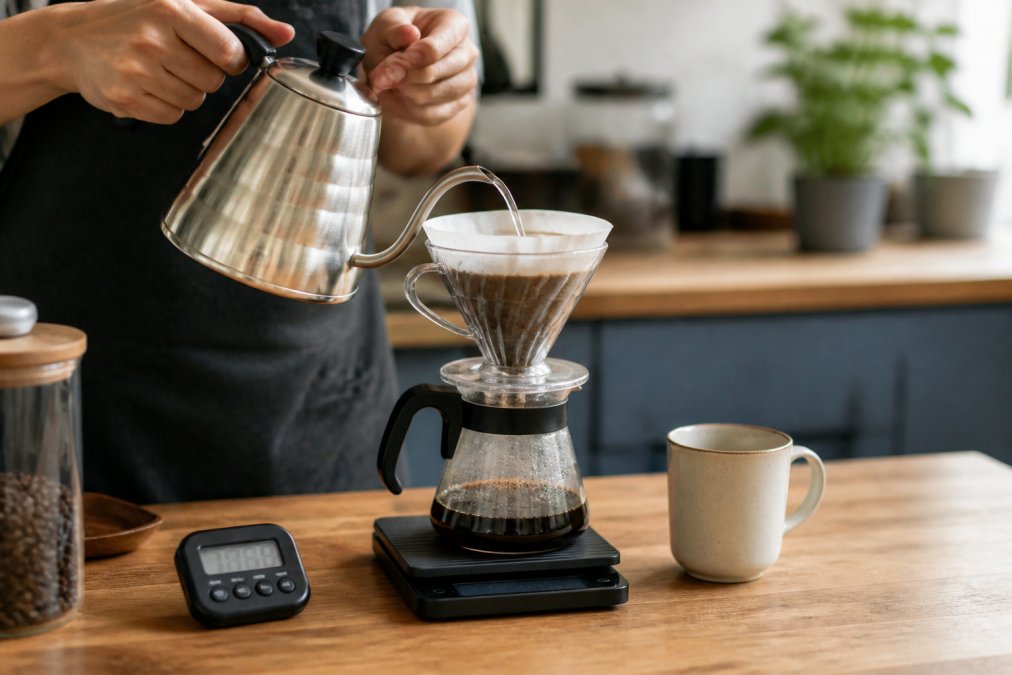
Here's how to brew fresh coffee using a pour-over method, the best starting point for beginners.
Step 1: Grind Your Beans Grind immediately before brewing. Use a medium grind (texture of sand). If water drains too fast, grind finer; if water pools, grind coarser.
Step 2: Heat Your Water Heat water to 195-205°F. Boil, then cool 30 seconds. Hotter water over-extracts (bitter); cooler water under-extracts (sour).
Step 3: Set Up Your Scale and Timer Place dripper and cup on scale, tare to zero, add 12.5 grams coffee (1:16 ratio), start timer.
Step 4: The Bloom (30 seconds) Pour water equal to roughly twice the coffee weight. Watch bubbles rise as CO2 escapes and extraction begins.
Step 5: Pour (3-4 minutes total) After bloom, pour slowly in circular motions. The scale shows when you've reached 200 grams of water.
Step 6: Wait and Observe Watch the slurry drain steadily. If it pools, grind finer next time; if it drains too fast, grind coarser.
Best Coffee Beans for Home Workers
The right bean choice eliminates half the brewing variables. Understanding what to look for saves money and frustration.
Freshness First: The Roast Date Rule
Freshness matters most. Coffee loses flavor after 2-4 weeks; after 4 weeks, flavors flatten and bitterness increases.
Always check the roast date. If none is printed, don't buy it. Grocery store beans often lack dates because they've sat on shelves for months.
Specialty roasters ship 3-5 days after roasting, balancing freshness with proper degassing. This timing prevents uneven extraction and preserves complexity.
Understanding Roast Levels and What They Taste Like
Roast level determines flavor profile and how the beans behave during brewing.
Light roast (City or City+): Preserves origin flavors with bright acidity and floral or fruity notes. Denser beans are less likely to over-extract in pour-over brewing. Ideal for learning what different origins taste like.
Medium roast (Full City): Balances origin characteristics with roasting flavors (nutty, chocolate, caramel). Works with all brewing methods and suits most palates.

Dark roast (French or Italian): Emphasizes roasting flavors (bold, smoky, charred) over origin. Produces less acidity and heavier body. Popular in French press and milk drinks, but easier to over-extract.
For beginners, start with a medium roast.
Single-Origin vs. Blended Beans
Single-origin beans come from one farm, region, or country and showcase unique characteristics. They vary seasonally and require more experimentation to dial in.
Budget-Friendly Entry Points (No Specialty Roaster Required)
If you're starting out and want to minimize investment, conventional sources work fine.
What to Look for on the Bag
Bag design with a one-way valve: This allows CO2 to escape while preventing oxygen from entering. It's a sign the roaster cares about freshness.
Storage to Maximize Freshness
Store whole beans in an airtight container away from light, heat, and moisture. Avoid the refrigerator or freezer, condensation damages beans.
How to Store Coffee Beans for Maximum Freshness
Storage determines how long your beans stay fresh. Whole beans stay flavorful for 2-4 weeks after roasting if stored correctly. Ground coffee degrades within days, another reason to grind fresh.
Troubleshooting Common Coffee Brewing Mistakes
Taste reveals what went wrong. Use the diagnostic table below to pinpoint problems and adjust one variable at a time.
The Taste-to-Cause Diagnostic Table
| What Your Coffee Tastes Like | Root Cause | What to Change First | Secondary Checks |
|---|---|---|---|
| Sour, tart, or vinegary | Under-extraction (water moved through grounds too fast) | Grind finer by one notch | Check water temperature (should be 195-205°F); increase brew time by 15-30 seconds |
| Bitter, harsh, or astringent | Over-extraction (water stayed in contact too long or was too hot) | Grind coarser by one notch | Lower water temperature to 200°F; reduce brew time by 15-30 seconds |
| Weak, watery, or thin | Incorrect ratio (too much water, not enough coffee) | Weigh your coffee; recalculate using 1:16 ratio | Verify you're using a scale, not eyeballing; check that beans are fresh (within 4 weeks of roast date) |
| Flat, muted, or one-dimensional | Stale beans (older than 4 weeks post-roast) or poor water quality | Order fresh beans roasted within the last 2 weeks | Use filtered water; check that your tap water isn't heavily chlorinated |
| Muddy or cloudy (French press only) | Grind too fine; sediment not fully settled | Use a coarser grind; wait 1 minute after pressing before pouring | Pour slowly to avoid stirring up settled grounds |
| Uneven flavor (some sips taste good, others don't) | Inconsistent grind size or uneven water distribution | Stir gently during bloom phase to break up clumps | Pour in slow, circular motions; ensure all grounds are saturated |
How to Taste Like a Beginner (And Improve Faster)
Instead, train yourself to notice three core taste dimensions:
Acidity (brightness): Does the coffee feel sharp or dull on your tongue? Under-extracted coffee tastes sour; properly extracted tastes bright; over-extracted tastes flat.
Common Beginner Mistakes to Avoid
Changing multiple variables at once. Adjust only one variable at a time to learn cause and effect.
Frequently Asked Questions
What is the golden ratio for brewing fresh coffee?
The golden ratio is 1:16, one part coffee to 16 parts water by weight. For example, 25 grams of coffee grounds with 400 grams of water produces a balanced cup. This ratio works across most brewing methods and helps beginners achieve consistent extraction without guesswork. Adjust slightly if you prefer stronger or lighter coffee, but this baseline delivers the smooth, balanced flavor most coffee drinkers enjoy.
How does water temperature affect the taste of my coffee?
Water temperature controls extraction speed. Too hot (over 205°F) over-extracts, causing bitter, harsh flavors. Too cool (under 195°F) under-extracts, leaving your coffee sour and thin. The sweet spot is 195-205°F. If you don't have a thermometer, let boiled water cool for 30 seconds before pouring. Temperature consistency matters because it determines how many coffee solubles dissolve into your cup, directly affecting taste and body.
Why does roasting date matter more than expiration date?
Fresh roasted coffee tastes better because the beans are still degassing and releasing aromatic compounds. Coffee reaches peak flavor 3-10 days after roasting and stays excellent for 2-4 weeks. Beans roasted to order, like those from Marilyn's Morning Brew, arrive at their flavor peak. Grocery store coffee often sits for months, losing brightness and complexity. Check the roast date on the bag, it's your real indicator of freshness, not the expiration date printed months away.
What grind size should I use for my brewing method?
Grind size controls how fast water extracts coffee flavor. Use coarse grinds (like sea salt) for French press and immersion methods, medium grinds for pour-over and drip machines, and fine grinds for espresso. A burr grinder gives you consistent particle size, which is essential, inconsistent grinds extract unevenly, creating bitter and sour flavors in the same cup. If you're just starting, a medium grind works safely across most methods.