

Best Coffee Brewing Methods for Remote Workers in 2026
Table of Contents
- Comparison Table: Brewing Methods at a Glance
- What Makes a Brewing Method Work for Remote Workers
- Pour-Over and Manual Brewing Methods
- Automatic Drip and Single-Cup Brewing
- Coffee Brewing Equipment for Small Spaces
- Benefits of Freshly Roasted Coffee for Productivity
- Best Coffee Subscription for Home Office
- Frequently Asked Questions
Last Updated: September 16, 2026
Comparison Table: Brewing Methods at a Glance
The best coffee brewing methods for remote workers balance three things grocery-store coffee can't offer: speed, low noise, and a genuinely fresh cup. This guide from Marilyn's Morning Brew breaks down the equipment that fits a home office, plus the workflow tricks that keep your mornings moving.
| Method | Time | Noise | Best For | Grind |
|---|---|---|---|---|
| Pour-over | 3-4 min | Low | Focused mornings, clean cup | Medium-fine |
| French press | 4-5 min | Low | Full-bodied coffee, batches | Coarse |
| AeroPress | 2-3 min | Low | Fast single cups, versatility | Medium-fine |
| Automatic drip | 5-8 min | Medium | Hands-off brewing | Medium |
| Single-serve capsules | 1-2 min | Medium | Back-to-back meetings | Pre-ground |
What Makes a Brewing Method Work for Remote Workers
A brewing method works for remote work when it fits the gaps between meetings, not the other way around. That means short brew times, minimal cleanup, and low noise so you don't broadcast your kettle to a client call.
- Time windows. A 15-minute gap between calls rules out anything with a 10-minute brew cycle.
- Noise. Grinders and pump-driven machines register clearly on microphones.
- Counter space. Most desks leave room for one compact station, not a full coffee bar.
Pour-Over and Manual Brewing Methods
Manual brewing gives you the most control over extraction, and it's the quietest option for a home office. No pumps, no pods, just you, hot water, and a filter.
Pour-Over: Control and Clarity
Pour-over produces a clean cup by passing water through a paper filter in stages. You bloom the grounds with a small pour first, wait about 30 seconds, then add the rest in slow circles.
French Press and AeroPress: Immersion Brewing
Immersion brewing steeps grounds fully in water, which pulls out a richer, full-bodied cup than drip. The French press is the classic version: coarse grind, four minutes, then press and pour. It's quiet and forgiving, and it brews two or three cups at once.
Automatic Drip and Single-Cup Brewing
Automatic machines trade a little control for a lot of convenience, and for many remote workers that's the right call. The key is matching the machine to your meeting schedule rather than your aspirations.
Drip Coffee Makers: Set It and Forget It
A drip coffee maker automates the entire process: add water and grounds, press start, walk away. Most models finish a full carafe in five to eight minutes, and programmable versions have a pot ready before your first call.
Single-Serve Capsules: Speed and Consistency
Single-serve capsules brew one cup in under two minutes with almost no cleanup, which is why they dominate home offices. Consistency is the real advantage: every cup tastes the same, and there's no measuring, no scale, and no guesswork.
Coffee Brewing Equipment for Small Spaces
Space is the constraint most brewing guides ignore. A compact home brew bar needs roughly the footprint of a laptop stand, and everything else stacks or stores. But footprint is only half the problem: the gear also has to stay quiet enough to survive a call, and efficient enough not to spike a home-office power draw.
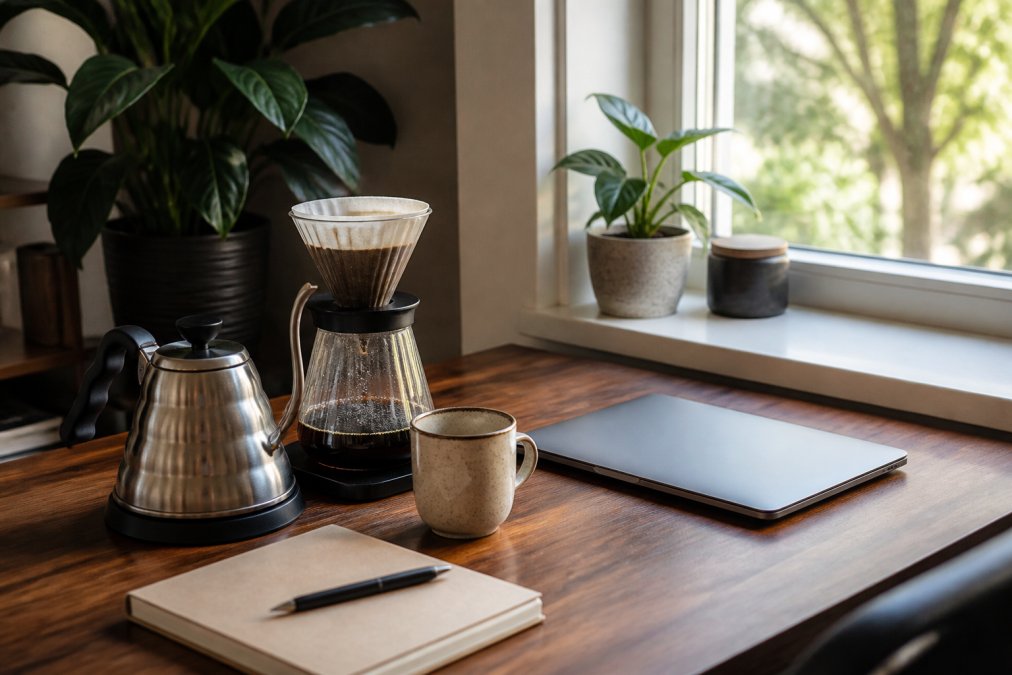
Footprint: Build Around a Laptop-Stand Footprint
Measure the free space to the side of your keyboard before you buy anything. A practical target is a rectangle about 10 inches wide by 14 inches deep, enough for a dripper, a small scale, and a mug, and nothing more. Anything larger forces a choice between your mouse and your mug.
Build your station around these essentials:
- A hand burr grinder. Hand grinders take up a fraction of the counter space of an electric model and produce the consistent particle size that blade grinders can't. A blade grinder pulverizes unevenly, which means some grounds over-extract and turn bitter while others under-extract and taste sour. Consistency matters more than any other single variable, and a hand burr grinder delivers it in a package you can drop in a drawer.
- A compact electric kettle with temperature control. Water just off boil suits most methods; delicate roasts do better a few degrees cooler. A gooseneck spout gives you pour control for manual brewing, and a 0.6- to 1-liter capacity is plenty for one person and stores easily.
- A small digital scale. Coffee-to-water ratio drives flavor more than technique does. A scale that reads to 0.1 gram lets you repeat a good cup instead of guessing.
- One mug you actually like. Marilyn's Morning Brew's White Glossy Mug is dishwasher and microwave safe, and the Mug With Color Inside adds a colored rim and handle if you want the ritual to feel less utilitarian.
Noise: What Your Microphone Actually Picks Up
Noise is the hidden spec sheet nobody prints. A pump-driven drip machine and an electric burr grinder both register clearly on a laptop microphone, and a client on the other end hears every second of it. Hand grinding is the quietest option available, it's essentially silent to anyone but you, which is why it pairs so well with a desk-based setup.


Power Draw: A Small but Real Home-Office Cost
Home-office gear runs on the same circuit as your monitor, laptop, and router, and brewing equipment is the thirstiest thing on the desk. An electric kettle draws the most power of any common kitchen appliance while it heats, often in the 1,000- to 1,500-watt range, but only for a few minutes. A drip machine pulls a few hundred watts while it brews, and a single-serve brewer spikes briefly during heat-up.
The Stack-and-Store Rule
If your desk can't spare the rectangle, the answer is a tray. Keep the grinder, scale, and dripper on a shallow tray that slides onto a shelf when you're done, and leave only the mug and kettle out. That keeps the brew station from colonizing the workspace and keeps the ritual contained to the minutes you actually have.
Benefits of Freshly Roasted Coffee for Productivity
Freshly roasted coffee tastes better, and better coffee changes how you use your breaks. The difference comes down to freshness: beans roasted to order and shipped quickly retain more of their aroma and flavor than bags that sat on a shelf for weeks.
Best Coffee Subscription for Home Office
The best coffee subscription for a home office does two jobs: it keeps fresh beans on hand so you never brew stale grounds mid-week, and it fits a delivery rhythm that matches how much coffee you actually drink while working from home. Look for roasters that roast to order rather than warehouse inventory, because freshness is the whole point.
Match the Delivery Cadence to Your Workweek
Most remote workers drink more coffee on workdays than weekends, and a subscription that ignores that pattern either runs out on Thursday or piles up bags you can't finish. A common pattern is to size the order to your weekday habit and let weekends be a bonus rather than a target.
- Heavy weekday drinker (three or more cups a day): a larger recurring bag or a multi-bag shipment keeps you covered without a mid-week scramble.
- Moderate drinker (one to two cups a day): a single bag on a predictable schedule is usually enough, and it stays fresh because you finish it before it fades.
- Meeting-heavy weeks: keep a fast backup on hand so a packed calendar never leaves you with nothing to brew.
The Workflow Angle: Brewing as a Scheduled Break
A subscription is really a scheduling tool. When beans arrive on a predictable date, you can plan brewing windows around them, a mid-morning cup between calls and an early-afternoon reset before the focus block. That structure keeps you from grazing on caffeine all day and gives the afternoon a natural shape.
A few options worth knowing about:
- Single-serve capsules for speed and zero cleanup between meetings.
- Cold Brew Coffee for a smooth, medium roast with chocolate, toffee, and floral notes, brewed ahead and poured over ice, useful when you want a cup ready before your first call.
- Instant Coffee for 30 servings in a resealable pouch when the schedule leaves no room at all.
- Coffee with mushrooms in dark roast or medium roast, infused with Lion's Mane, Cordyceps, and Reishi, for anyone who wants a specialty-grade cup with something extra.
Storage: The Part Subscriptions Get Wrong
Fresh beans fade faster than most people expect once the bag is open. Keep the bag sealed and away from light and heat, and buy in a size you'll finish within a few weeks rather than stockpiling. If you order more than you can drink, freeze the extra in an airtight container and grind from frozen, it preserves far more flavor than leaving a half-empty bag on the counter.

Frequently Asked Questions
What are the four best coffee brewing methods for remote workers?
The four methods that work best for remote workers are pour-over, French press, automatic drip, and single-serve capsules. Pour-over gives you control over extraction and a clean cup. French press is full-bodied and needs no paper filters. Automatic drip is the most hands-off. Single-serve capsules are the fastest when you are between meetings. Each method fits a different workspace and schedule.
Which brewing method is fastest for a busy remote work schedule?
Single-serve capsules are the fastest, taking about 60 to 90 seconds from start to finish. Instant coffee is even quicker if you just need caffeine before a call. For a step up in flavor without much time, an AeroPress brews in roughly two minutes. Pour-over and French press take four to five minutes, which is still manageable if you start the kettle before your first meeting.
How does a coffee subscription improve the remote work experience?
A subscription delivers freshly roasted beans on a set schedule, so you are not making last-minute store runs during the workday. The best coffee subscription for home office use keeps your supply steady and lets you try different roasts without leaving your desk. Marilyn's Morning Brew roasts to order and ships directly to your door, which means the beans arrive fresh rather than sitting on a shelf.
What is the 15-15-15 coffee rule?
The 15-15-15 rule is a simple guideline for dialing in a good cup: use a 1:15 coffee-to-water ratio, aim for a 15-minute window after brewing to drink it at peak flavor, and keep your total brew time around 15 minutes from grind to cleanup. It is not a strict formula, but it helps remote workers stay consistent without weighing every gram.